
DE | EN | FR

Leadership Simulation Ambiguity · Cultural Tension · Critical Momentum:
Mastering High-Stakes Change

Transformation cannot be explained. It must be experienced.

Disconnect autopilot.
Take the controls and fly the turbulence.

International Leadership Simulation: Agile Leadership & Digital Transformation

Technology creates possibilities. People create impact. The most advanced cockpit is useless if the crew fails in a storm.

Capability beats knowledge
Transformation succeeds when expertise and human behaviour interact perfectly under pressure.

The Leadership Simulator is the place where this dynamic becomes visible and trainable.
safe. realistic. impactful.

Transformation Simulations

> COCKPIT SIMULATION

Training for Transformation Turbulence

In a real cockpit simulator, human reactions to system statuses are trained. Our simulator focusses on the critical hazards within the change process:
  • Creeping Icing When buzzwords ice over the wings of integration: the company loses lift while the instruments are still reporting a "normal flight".
  • The Homemade Stall When targets are overpitched so steeply that the connection to reality snaps: the nose is pointing up, but the airflow has long since stalled.

Mission Control: Ready for Take-off?

Select a system for the 180-second test flight:

Crosswind Point
Dynamic Ambivalence:
Between conviction and doubt.
Load Flight Pattern
Convergence Zone
Cultural Friction:
Between perspective and misunderstanding.
Load Flight Pattern
Velocity Limit
Critical Momentum:
Between opportunity and risk.
Load Flight Pattern

Ready for the test flight?

Crosswind Point: Executive decision-making under uncertainty

Leadership Simulation: Building the ability to act under Ambiguity, time pressure, and complexity

Ambiguity is the default state of modern leadership.
Tight deadlines. Incomplete data. Leading under pressure means navigating shades of grey.

This international leadership simulation reveals how you steer through critical moments when clarity is scarce.

Volatility meets Tolerance for Ambiguity.

LIVE Flight Pattern

Crosswind Point Monday, 08:17 am
Coffee cup

Monday, 08:17 am. Four messages are waiting. Take a moment to look them over.

Time remaining

Open whatever demands your attention first.

Urgent Update · 08:18 am · Controlling
"Note: The evaluation for the board meeting might contain a linking error. Please do not forward it yet."

Arrange the four items into your final order. Rank 1 — highest priority.

Initial Reflex
What Remained Unread
Consistency or Revision
The Psychological Twist

The sequence of decisions often reveals more than the decisions themselves.

Under pressure, decisions are rarely entirely rational — reactions are frequently reflexive and selectively revised. The question is not whether your pattern was right or wrong — but whether you would have recognised it if no one had pointed it out.

The Journey

Simulation Design: From Reflex to Insight

Explore the stages via hover or click for detailed insights.

01. The Trigger 02. The Reflex 03. The Pattern 04. The Action 05. The Archetype 06. The Reflection 07. The Echo
01

The Stress Scenario

Unexpected events generate time pressure and uncertainty. Under these conditions, deeply ingrained decision-making and behavioral patterns become visible.

02

Cognitive & Emotional Patterns

Even before a conscious decision is made, the brain interprets the situation. Thoughts, expectations, and emotions heavily influence what is perceived as sensible or risky.

03

The Response Profile

What appears to be a spontaneous reaction often follows recurring structures. The simulation makes this underlying decision logic visible.
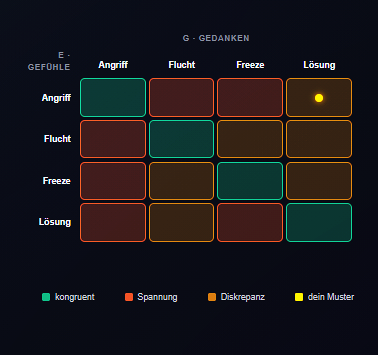
Response Profile Preview View Fullscreen
04

Alternative Actions

Every action card unlocks a new path while closing others. Operating under time constraints and with incomplete data reveals exactly how you navigate decisions.
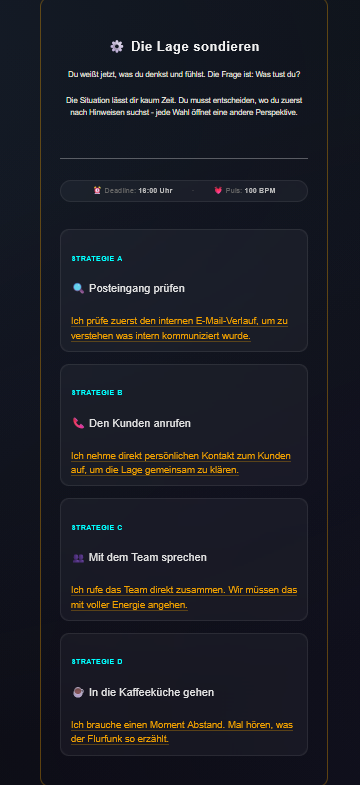
Action Cards Preview View Fullscreen
05

The Archetype

The Archetype condenses recurring decision-making and behavioral patterns into a clear, comprehensive profile of your preferred leadership logic.
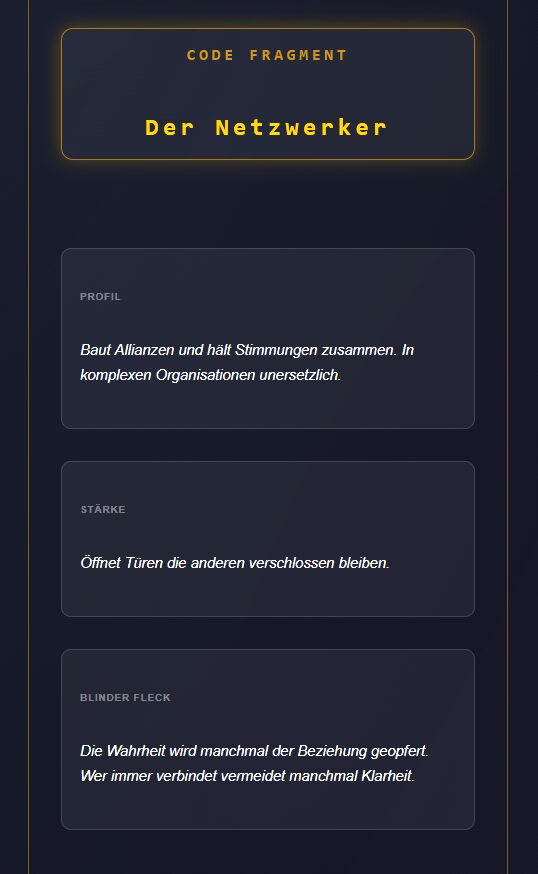
Archetype Character Portrait View Fullscreen
06

Feedback & Practice

The simulation delivers non-judgmental feedback and translates insights into concrete exercises, creating new behavioral options for everyday leadership challenges.

07

The Transfer Question

Sustainable learning often begins after the simulation ends. A targeted reflection question reinforces and supports the transfer of insights into daily practice.

The Stress Scenario

An unexpected situation demands immediate action. Time pressure, uncertainty, or conflicts generate the friction required to reveal authentic behavioral patterns.

Cognitive & Emotional Patterns

Before a conscious choice is finalized, internal assessments take shape. Which dominant thoughts arise—and which emotion takes the wheel?

The Response Profile

What outwardly appears to be a spontaneous reaction often follows a deeply embedded, recurring pattern. The simulation brings this baseline to light.

Response Profile Preview View Fullscreen

Alternative Actions

Theory becomes practice. The action cards demand decisions under realistic constraints—featuring limited time, incomplete information, and tangible consequences.

Action Cards Preview View Fullscreen

The Archetype

The Archetype condenses complex core behaviors into a clear, high-fidelity mirror of your signature reaction logic.

Archetype Character Portrait View Fullscreen

Feedback & Practice

The simulation mirrors your leadership behavior objectively and without evaluation. This translates into tailored practice, introducing alternative execution styles to your routine.

The Closing Question

The most profound breakthroughs often crystalize after the simulation concludes. A strategic reflection question effectively bridges the gap into daily operational execution.

× Fullscreen View

Convergence Zone: Cross-Cultural Behavioral Dynamics Under Pressure

Leadership Simulation: Aligning High-Performance Teams When Contrasting Realities Collide

There is no neutral perspective in global business.
Strategic choices are shaped by cultural conditioning, deep-seated bias, and unspoken assumptions. The exact same facts yield entirely different interpretations.

Experience the powerful team dynamics that unfold when diverse leadership perspectives collide under real-time stress.
Where contrasting views converge, organizational culture becomes visible.

LIVE Flight Pattern

Supply Chain Rupture Observation Deck
Arne · Operations
Taylor · Sales
Chloé · Strategy
You
 
A key supplier in Asia shuts down without warning. A major client’s delivery is at risk. Three locations join the emergency call.
Channel Tension 0%
Three directors. Three readings of the same crisis.
The channel is open. How do you intervene?
Outcome

The call does not resolve.

No one in this room was wrong. Each director was simply fluent in a different language — shaped by role, by culture, by what their part of the business has taught them to protect.

This is precisely where our Simulations begin. Teams learn to spot these silos early — before a real crisis forces the issue.

the journey

Cockpit View

Three Cultures. One Project. Three Realities.

Why do good projects fail despite good people?

01

Recognizing People Behind Roles

Not every agreement means alignment. Not every objection is resistance. Those who understand motives, mindsets, and cultural footprints lead more effectively.

02

Experiencing Dynamics in Real-Time

As long as everything runs smoothly, most teams function well. It is only under pressure that power dynamics, conflicts, and cultural divides truly emerge.

03

Dissolving Blind Spots

Overlooked signals, unconscious biases, misplaced interventions: leadership often fails in the shadows. The simulation exposes both dominant and missing perspectives.
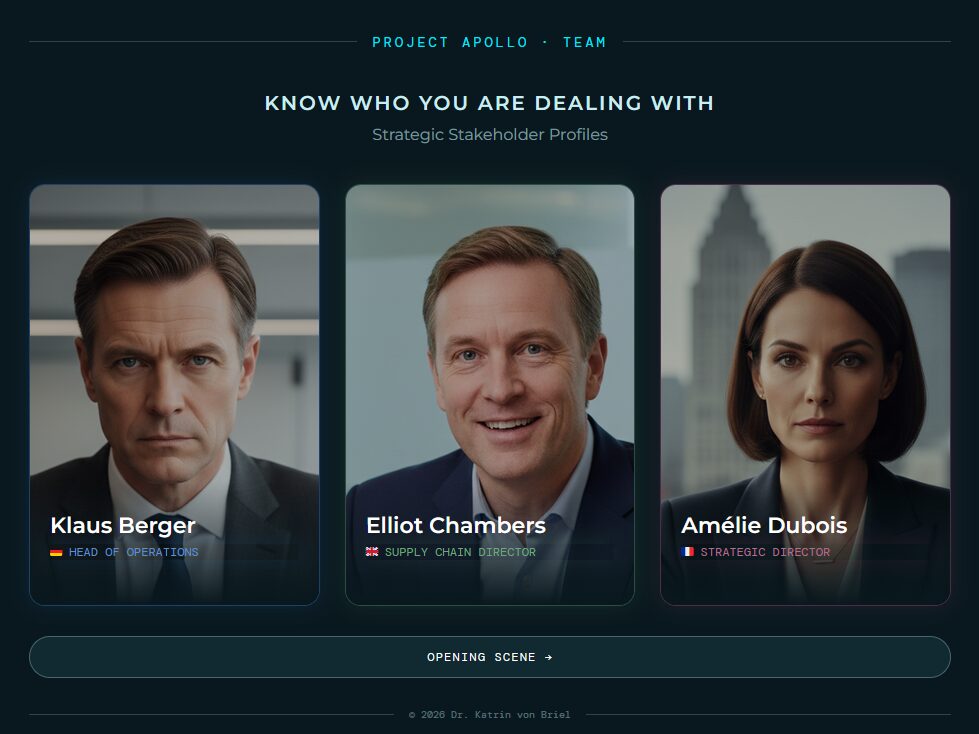
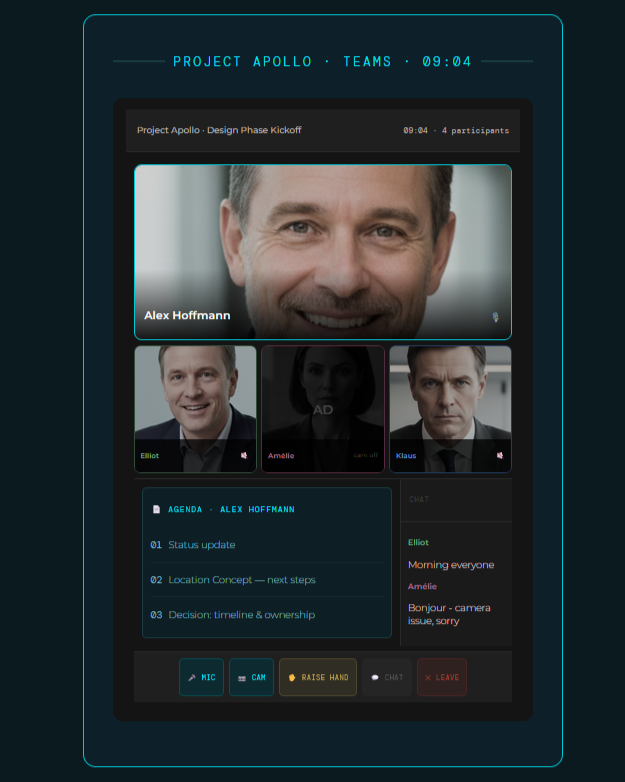
Stakeholder Profile Dilemma Tracking Alignment Radar

Velocity Limit: Overcoming Analysis Paralysis in High-Stakes Environments

Leadership Simulation: Recognising When Further Analysis Stalls Organisational Momentum


More information rarely yields more clarity.
Only a false sense of security.

LIVE Flight Pattern

Window of Opportunity Briefing

A small technology boutique is offering a cutting-edge digitization system that is not yet fully mature. Initial pilot projects indicate exceptional outcomes. If it becomes a breakthrough, it will generate a massive competitive advantage—and the startup is offering exclusive early-mover access.
Opportunity

The investment is financially manageable, but far from risk-free. No one can guarantee if the technology will actually scale. You have 180 seconds to make your decision.

How attractive does this opportunity appear to you?
50%
How confident are you in this initial assessment?
50%
Time Remaining180s
03:00
Competitive Advantage100%
100%
Market Intelligence
Consulted Sources
No sources consulted yet.

How confident are you in your position now?
50%
Your Decision Profile
Time Spent
Sources Used
Retained Advantage
Final Choice
Initial Attractiveness
Confidence Shift
Reflection

When do you know enough to act? This simulation has no hidden "correct" answer. Gathering more data did not necessarily make your path clearer—it consumed valuable time, which was a core parameter of the decision itself.

THE JOURNEY

Window of Opportunity // The Journey

Navigating Ambiguity

Opportunities follow no agenda. They emerge unexpectedly, evolve constantly, and vanish just as quickly. This simulation reveals how leaders make decisions.

01
Trigger

Oppor­tunity

A compelling opportunity emerges – offering high potential but bound by incomplete information.

02
Certainty or Speed?

Trade-off

Further analysis yields insight but consumes precious time. While you deliberate, the market moves.

03
Risk Horizons

De­cision

When do you act? The simulation reveals the structural consequences and your inherent leadership style.

Window of Opportunity // The Paradox

The Perpetual Risk Paradox

Most executives manage the risk of acting. The best also manage the risk of inaction.

Offensive Opportunity Risk
  • Deciding too early
  • Flawed execution
  • Insufficient data
  • Actionism
Opportunity Trigger
Defensive Certainty Risk
  • Deciding too late
  • Missed opportunity
  • Information overload
  • Analysis Paralysis
“To move too early is to risk failure. To wait too long is to risk a missed opportunity. The window only opens for those who can withstand both risks.”
Velocity Limit // Dynamic Balance

FLIGHT DECK

PASSENGER INFO

Establish Radio Contact

Clear for Takeoff?

Take control. Let’s configure the parameters for your inaugural test flight.

VHF 121.50 — Secure Line
Nach oben scrollen